


Facial aging is a complex process affecting the skin, fatty tissue, and the structures that support the face. Over time, skin elasticity decreases, wrinkles and changes in skin texture appear, and alterations in tissue distribution and volume may occur. For this reason, facial rejuvenation is not solely about restoring volume; for some patients, improving skin characteristics may also be necessary.
Facial Nanofat is a technique that uses the patient’s own adipose tissue—processed via a specific procedure—to create a preparation that can be applied to specific areas of the face. Its primary goal is to improve skin quality rather than to produce significant volume augmentation. Consequently, it can be part of a personalized facial rejuvenation treatment plan, following a medical assessment.
What is Nanofat?
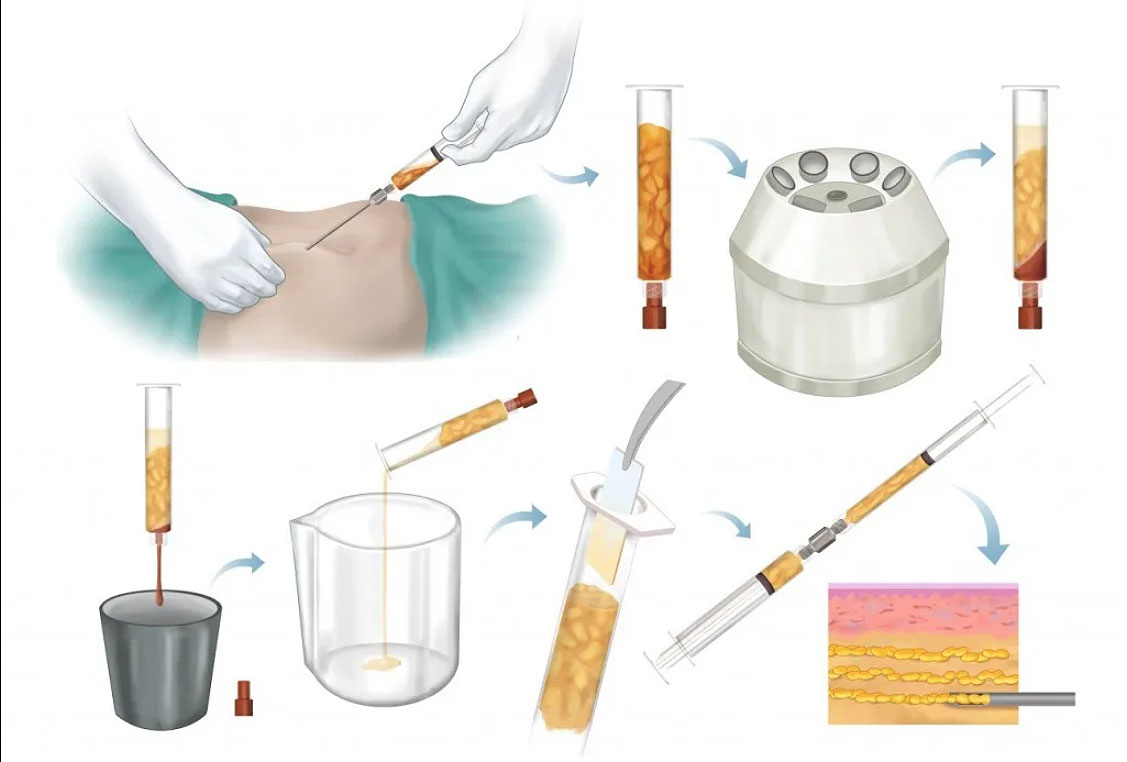
Nanofat is a preparation derived from a small amount of autologous fat—that is, fat taken from the patient’s own body. The procedure begins with the extraction of adipose tissue using a liposuction technique. Subsequently, this fat is processed through specific emulsification and filtration systems to produce a preparation consisting of very small particles.
This process alters the characteristics of the original adipose tissue, enabling its use in applications aimed at improving specific aspects of the skin. Interest in Nanofat stems from the presence of various cellular components and biological factors within the adipose tissue. However, its mechanisms of action and the extent of its clinical benefits remain subjects of ongoing research, and results can vary significantly among patients. From a medical perspective, it is important to distinguish Nanofat from other fat transfer techniques.
Differences between Nanofat and facial lipofilling
Although both techniques use the patient’s own fat, they do not serve exactly the same purpose:
- Nanofat: used primarily to improve specific aspects of skin quality.
- Facial lipofilling: involves transferring fat to restore or add volume to specific areas of the face.
- Facelift: a surgical technique designed to address sagging and the descent of facial and neck tissues.
In some cases, these techniques can be combined, but the choice will depend on each patient’s anatomical characteristics and needs.
What is facial Nanofat used for?
Nanofat can be used as a complement to certain facial rejuvenation treatments. Its potential applications include:
Improving skin quality
The treatment may be considered for patients with thin or aging skin, or skin showing signs of age-related changes.
The goal is to improve specific aspects of the skin, such as its texture, appearance, and overall quality. However, patient response varies, and specific results cannot be guaranteed.
Treating specific areas of the face
Nanofat can be applied to selected areas of the face when there is an appropriate medical indication.
These areas include certain periocular regions; however, treating the eye contour requires particularly careful assessment due to the anatomical characteristics of this area.
Improving the appearance of certain scars
In specific cases, Nanofat can be used as a complementary treatment for certain scars, provided the characteristics of the scar and the surrounding tissue allow for it.
Suitability for the procedure depends on the type of scar, its age, its location, and available therapeutic alternatives.
Complementing other rejuvenation treatments
Nanofat can be part of a broader treatment plan alongside other aesthetic medicine or plastic surgery techniques.
However, it does not replace procedures designed to correct issues that require a different type of approach.
Nanofat for under-eye circles: can it be used on the eye contour?
The eye contour is one of the areas that worries many patients the most when signs of facial aging begin to appear.
The skin in this region is especially thin and delicate. In addition, dark circles can have different causes:
- Skin pigmentation.
- Sinking of the nasojugal fold.
- Loss of volume.
- Vascular alterations.
- Skin sagging.
- Genetic or anatomical factors.
For this reason, not all dark circles can be treated with Nanofat.
In certain patients, this technique can be considered as a complement to improve the quality of the skin in the periocular area. In other cases, it may be necessary to resort to different treatments, such as volume replacement techniques, eyelid surgery or other procedures.
The choice depends on the predominant cause of dark circles and the individual characteristics of each patient.
How is the Nanofat treatment performed?
The procedure is carried out in several phases.
- Medical assessment
Before performing the treatment, it is necessary to evaluate the condition of the skin, facial characteristics, and the areas targeted for improvement. The consultation also involves assessing medical history, patient expectations, and the potential suitability of alternative treatments. - Fat extraction
Adipose tissue is obtained via a minor liposuction procedure from a body area with sufficient fat reserves. While the required amount is typically small, the availability of adipose tissue must be assessed on an individual basis. - Processing the adipose tissue
The extracted fat undergoes a specific preparation process, which may include emulsification and filtration. The goal is to obtain a preparation consisting of very fine particles suitable for the planned technique. - Application to selected areas
The Nanofat is injected into the target areas using fine-gauge needles or cannulas. The application technique depends on the treatment area, skin characteristics, and the surgeon’s clinical judgment. The procedure can be performed as a standalone treatment or in conjunction with other interventions, depending on the patient’s needs.
How long does the effect of Nanofat last?
The duration of Nanofat’s effects is a topic of great interest; however, there is no exact timeframe that can be guaranteed for every patient.
The outcome depends on various factors:
- Age and individual characteristics.
- Initial skin quality.
- The treated area.
- The technique used.
- Each patient’s biological response.
- The natural aging process.
Furthermore, it is important to distinguish between the initial changes observed after the procedure and the evolution of skin quality over the medium term.
Nanofat does not stop the aging process. Its purpose is to improve specific tissue characteristics, so its effects must be viewed within the context of a natural process that continues over time.
When do you start to see results?
Following the treatment, swelling, bruising, or some tenderness may occur in the treated zones and the extraction site. During the initial days, the appearance of the face may be affected by the recovery process itself. Progress is gradual, and results should not be assessed immediately after the procedure. For treatments aimed at improving skin quality, changes may become apparent over the course of several weeks or months. The appropriate time to evaluate the outcome will depend on the technique used and the individual patient’s progress.
Aftercare for Facial Nanofat Grafting
Post-procedure recommendations must be tailored to each individual case, especially when the Nanofat procedure is performed in conjunction with another intervention.
In general, it is important to:
- Follow medical advice. Instructions provided by the surgeon take precedence over any general recommendations.
- Avoid strenuous physical exertion. During the specified period, it may be necessary to limit exercise and certain physical activities.
- Avoid manipulating the treated areas. Do not massage or apply pressure to the treated areas unless expressly instructed to do so by the medical team.
- Protect the skin from the sun. Sun protection is important during recovery and is part of standard care for skin that has undergone a procedure.
- Avoid intense heat sources. Saunas, very hot baths, and other heat sources may be contraindicated during the recovery period established by the surgeon.
- Attend follow-up appointments. Follow-up visits allow for monitoring progress, assessing tissue response, and detecting any potential issues.
Recovery may vary depending on the treated area, the amount of tissue used, and any associated procedures.
¿Who is the ideal candidate for Nanofat?
Suitability for Nanofat treatment must be determined through an individualized medical assessment.
In general terms, it may be considered for individuals who:
- Show specific signs of skin aging.
- Wish to improve skin quality using a technique that utilizes autologous tissue.
- Have a sufficient amount of adipose tissue for extraction.
- Have realistic expectations regarding the results.
- Have no contraindications for the procedure.
- Understand that the treatment does not halt the aging process.
Age alone does not determine candidacy. It is also essential to identify the specific issue to be corrected. Thin or aging skin, volume loss, and significant sagging are distinct conditions that may require different treatments.
When might another treatment be more appropriate?
Nanofat is not a universal solution for facial rejuvenation.
When there is significant volume loss, it may be necessary to consider fat grafting (lipofilling) or another volume-restoring technique.
If the primary issue is facial or neck laxity, treatment may require a surgical procedure, such as a cervicofacial lift.
For patients with excess eyelid skin, fat bags, or structural changes in the eye contour, it may be necessary to evaluate the need for blepharoplasty or another alternative.
In some cases, Nanofat can be used as a complement, but it does not replace surgery when an anatomical issue requires surgical correction.